
Author: Fr Chris

  • A Call For Celebration This June

    We hope that you will join us on every Sunday this June as we gather to worship King Jesus. And throughout the month, we also invite you to remember the faithful testimony of saints and martyrs who proclaimed Jesus to the end.

    There are many great men and women to remember, honor, and celebrate during this month of June. We aim to be governed by a faith and by a philosophy that spans throughout time and culture, honoring men and women from different ages, with different outlooks on the world, all united by One Spirit in humility before King Jesus.

    Today, on this 1st day of June, we remember Justin, Teacher of the Faith and Martyr at Rome, c. 165.

    Writing in the late 2nd century, Methodius of Olympus remembered Justin, “Justin of Neapolis, a man who was not far separated from the apostles either in age or excellence.” Rod Bennett comments, “Justin found Christ while still a philosopher and remained a philosopher to the end. For Justin the good news about Jesus was the missing piece of Socrates’ puzzle–and philosophy turned out to be the schoolmaster that brought him to Christ. He took up the ministry pioneered by Paul at Mars Hill, and [quoting early 2nd century historian, Eusebius Pamphilus] “wearing the garb of a philosopher he proclaimed the divine message, and contended by means of his writings on behalf of the Faith.” Not surprisingly, this mission eventually cost Justin his life and earned him that glorious title [“Martyr”] which popular usage has affixed to his own forever as a kind of surname.”

    This is the wise philosopher, Justin of Neapolis, “Justin Martyr”, whom we remember on this 1st day of June. After encountering an old Christian man on a walk in the wilderness, a nameless old man who testified of the greatest philosopher who ever lived, Jesus Christ, Justin saw reason, he turned around, and he followed Jesus the rest of his life until his martyrdom in Rome in A.D. 165. Justin wrote,

    “When [this old man] had spoken these and many other things, which there is no time for mentioning at present, he went away, bidding me attend to them; and I have not seen him since. But straightaway a flame was kindled in my soul; and a love of the prophets, and of those men who are friends of Christ, possessed me; and whilst revolving his words in my mind, I found this philosophy alone to be safe and profitable. Thus, and for this reason, I am a philosopher. Moreover, I would wish that all, making a resolution similar to my own, do not keep themselves away from the words of the Savior. For they possess a terrible power in themselves, and are sufficient to inspire those who turn aside from the path of rectitude with awe; while the sweetest rest is afforded those who make a diligent practice of them. If, then, you have any concern for yourself, and if you are eagerly looking for salvation, and if you believe in God, you may–since you are not indifferent to the matter–become acquainted with the Christ of God, and, after being initiated, live a happy life.”

    Amen and amen.

    Won’t you join saints throughout the world and throughout the ages and remember these holy saints and martyrs during this month of June?

    I pray that you will.

    Yours ever,
    Fr Chris+
  • The Light of the World

    Logan Brown

    1 Samuel 16:1–13
    Psalm 23
    Ephesians 5:1–14
    John 9:1–13, 28–41

  • Strike the Rock!

    Fr Chris Borah

    Exodus 17:1–7
    Psalm 95
    Romans 1:16–32
    John 4:5–42

  • Shout Your Prayer

    Fr Chris Borah

    Genesis 12:1–9
    Psalm 33
    Romans 4:1–17
    John 3:1–16

  • Lenten Prayer Guide

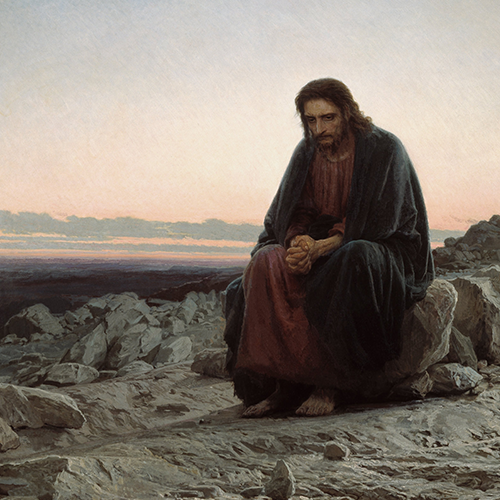
    “Christ in the Wilderness” by Ivan Kramskoy

    “There is not in the world a kind of life more sweet and delightful than that of a continual conversation with God. Those only can comprehend it who practice and experience it.”

    Brother Lawrence, The Practice of the Presence of God, (Letter No. 5)

    During this Season of Lent, I am inviting our people to “practice the presence of God,” to live each moment, with more and more intention, in the light of God’s presence.

    To seek God, to practice the pursuit of “continual conversation” with Him is not easy. But it is better than all of the empty deceits of this world. We seek respite and solace in countless diversions (entertainment, social media) and trying to numb our pain (with [self-]medication or, even, we try to numb pain with pain).

    “The single most important piece of advice about prayer is one word: Begin!”

    Peter Kreeft, Prayer for Beginners, p. 25.

    How are we even supposed to begin to “practice the presence of God?”

    Ignatius’ Examen

    If you are willing, I invite you to put down your phone throughout your day, and in its place, (but even if you don’t leave your phone behind) carry a pen and a physical prayer journal. In this pocket journal, I invite you to practice the ancient Christian discipline of the Examen.

    Traditionally, the Examen is done at the end of the day. Here’s the basic outline…

    • Presence – First, in silence (don’t rush this step), you turn your attention to God and ask Him to shine his light upon you – “Please God, let me know (and even feel) your presence now.” You may also meditate upon a verse of Holy Scripture.
    • Consolation – You then give thanks for all of the many blessings of the day, the ways that God’s grace was evident in small and big moments.
    • Desolation – Then, after giving thanks, review your day and bring to mind all of the things, internally and externally, that led you away from God, both your own sins and sins against you, troubles that you have brought upon yourself, and trials that have come upon you from outside yourself.
    • Obedience – Then ask, where is God leading me? Where might I live in deeper obedience? Conviction of sin? Where do I need God to be present in my moments tomorrow?
    • Prayer – Finally, pray compline (or short form at the end of day) and make intercessions for others.

    Here’s the problem (at least for me)… If I wait until the end of my day, very often, my list of “desolations” is far greater than my “consolations.” All of the things that have troubled me throughout the day (desolations) – difficult circumstances, my sins that hound me all day long, my lack of devotion to God in so many places – all of these are in my mind, and I will forget about the little graces (consolations) of my day.

    This is where the small pocket prayer journal comes.

    Even if you do still have your phone with you, you can use it to pray the Examen (“Daily reflection” in the app) with the Hallow prayer app.

    Instead of carrying around my phone, hounded by endless distraction, what if I paid attention to the good gifts and graces ever before my face this Lenten season? What if I wrote down my trials and my sins in the moment so that I might not forget to bring them into the Light of God’s mercy and healing?

    So what’s a “desolation” and a “consolation” again?

    These old words are good for a couple of reasons, but at the very least, desolations and consolations contain many different ideas.

    Desolations are simply described as everything that leads me to live in doubt, fear, and anger.

    Desolations can be my own sins, but they can also be someone else’s sin against me (and even after that, my unhelpful or sinful response to someone else’s sin against me is exposed).

    Accordingly, consolations are simply described as everything that leads me to live with faith, hope, and love.

    Consolations can be kindnesses towards me from someone else, the felt presence of God’s grace inwardly, or even the experience of giving glory to God for the beauty of the sunrise. Vinita Hampton Wright has some very helpful notes (and a very helpful article) to help us discern living in desolation or living in consolation for our own examen prayer journal.

    Desolation

    • Turns us in on ourselves
    • Drives us down the spiral ever deeper into our own negative feelings
    • Cuts us off from community
    • Makes us want to give up on the things that used to be important to us
    • Takes over our whole consciousness and crowds out our distant vision
    • Covers up all our landmarks [the signs of our journey with God so far]
    • Drains us of energy

    Consolation

    • Directs our focus outside and beyond ourselves
    • Lifts our hearts so that we can see the joys and sorrows of other people
    • Bonds us more closely to our human community
    • Generates new inspiration and ideas
    • Restores balance and refreshes our inner vision
    • Shows us where God is active in our lives and where God is leading us
    • Releases new energy in us
    Vinita Hampton Wright, ignatianspirituality.com

    I will pray for you this Lent, and I invite you to please pray for me as well.

    Yours ever,
    Fr Chris+

  • Original Sin

    Fr Chris Borah

    Genesis 2:4–3:7
    Psalm 51:1–12
    Romans 5:12–21
    Matthew 4:1–11

  • The House of Bread & Wine

    Fr Chris Borah

    Joel 2:1–2, 12–17
    Psalm 103:8–14
    2 Corinthians 5:20–6:10
    Matthew 6:1–6, 16–21

  • Experiencing Jesus

    Fr Chris Borah

    Exodus 24:12–18
    Psalm 99
    Philippians 3:7–14
    Matthew 17:1–9

  • Angry?

    Fr Chris Borah

    Sirach 15:11–20
    Psalm 119:1–16
    I Corinthians 3:1–9
    Matthew 5:21–37

  • The Name

    Fr Chris Borah

    Amos 3:1–11
    Psalm 139:1–18
    I Corinthians 1:10–17
    Matthew 4:12–22